Introduction
Buying an industrial DTG printer is not the same as buying a desktop printer for samples. The equipment sits inside a production system that includes artwork preparation, garment handling, pretreatment, curing, operators, maintenance, quality checks, packing and delivery. A machine can look impressive in a demonstration yet still be the wrong fit if its print area, white-ink workflow, service plan or daily capacity does not match the buyer's operation.
This guide is for garment factories, commercial print shops, apparel brands and print-on-demand (POD) operators evaluating a production-ready direct-to-garment solution. It explains what to ask before requesting a quote, what a meaningful factory test looks like, and how to compare proposals without reducing the decision to one headline number.
The goal is a repeatable production process. A good industrial DTG printer should help a team produce consistent garments within an agreed workflow; it should not create a new bottleneck around colour, white ink, operator intervention or shipment support.
Start With the Job, Not the Machine
Before comparing printer models, define the work the printer must perform. Suppliers can then recommend a configuration against a clear brief rather than a vague request for “the fastest machine.”
Questions to answer internally
- What garments will be printed? Record fabric composition, colour, size range, seams, zips, pockets and difficult placements. Cotton, blends and dark garments can require different pretreatment and white-ink settings.
- What is the order profile? Separate samples, short custom runs, repeat wholesale orders and variable POD orders. A business receiving many one-off designs has different workflow needs from a factory running the same artwork across a batch.
- What is the required print area? Measure the sellable design area on the actual garments. Do not select a printer only from its nominal platen size; allow for safe margins and garment positioning.
- What does a shift look like? Estimate production hours, operator availability, planned cleaning time and expected peak periods. Capacity should be discussed as a range based on artwork coverage and print mode, not as a single universal number.
- How will the print be cured and checked? Printing is only one stage. The finishing method, wash testing standard and inspection point must be defined at the same time.
A useful request-for-quotation brief
When contacting an industrial DTG manufacturer, send a short production brief: target products, daily or weekly order range, typical artwork files, dark-to-light garment mix, electrical supply, delivery country, installation space and support expectations. This gives the supplier enough context to propose the right machine, ancillary equipment and installation preparation.
Evaluate the Entire DTG Workflow
An industrial printer should be assessed as part of a line. The most useful supplier conversation follows the garment from incoming stock to packed order.
1. Artwork and RIP preparation
Ask which file formats, colour-management process and RIP workflow are included. The important question is not merely whether a RIP package is offered; it is whether the operator can create repeatable presets for the buyer's garments and artwork types. A factory should retain approved production recipes and file-handling rules so repeat jobs do not begin from zero.
2. Garment preparation and loading
Poor loading causes skewed prints, missed seams and inconsistent placement. Review the platen system, garment alignment method and access around the machine. For POD and short runs, changeover time can be as important as print time. For repeated wholesale jobs, stable positioning and operator ergonomics reduce avoidable variation across a shift.
3. Pretreatment and white ink
For dark garments, pretreatment and white ink are central to print quality. Ask the supplier to explain the recommended pretreatment process for the intended fabrics, drying or pressing conditions, white-ink circulation and daily maintenance routine. No responsible supplier should promise identical results on every garment without testing the fabric and artwork.
During a factory test, request a dark cotton garment with a representative image. Inspect fine text, pale highlights, solid colour areas and edge detail after curing. If wash durability matters for your market, agree on a test method and record the result rather than relying on a screen image alone.
4. Printing and curing
“Print speed” should always be qualified. Coverage, resolution mode, white underbase, garment size, platen loading, number of passes and operator workflow all affect realised output. Ask for a timed demonstration of a defined job: for example, a dark T-shirt with specified artwork coverage. Then include loading, printing, unloading and normal operator handling in the discussion.
The curing step deserves equal attention. A print can look good immediately after printing but fail if the curing process is unsuitable. Confirm the compatible curing equipment, temperature-control approach, garment movement and how the team will verify a finished item before packing.
Compare Machine Specifications With Production Relevance
Technical specifications matter when they answer an operating question. The table below turns common terms into due-diligence questions.
| Specification area | What to ask | Why it matters |
|---|---|---|
| Print area | What is the usable area for our garments and placements? | Prevents a platen size that does not suit the sellable design range. |
| Print heads | Which head configuration is supplied and what are the daily care requirements? | Helps plan quality, maintenance and consumable support. |
| Resolution and modes | Which modes will be used for our artwork and fabrics? | A headline maximum resolution does not define normal production output. |
| Ink configuration | How are CMYK and white ink managed, circulated and stored? | White ink needs disciplined handling in production. |
| Media compatibility | Which cotton and blend garments have been tested? | Fabric finish, colour and construction influence results. |
| Machine dimensions | What are machine, access and maintenance clearances? | Installation failures often start with insufficient space. |
| Electrical requirements | What power supply, grounding and environmental conditions are needed? | Essential for site preparation and safe commissioning. |
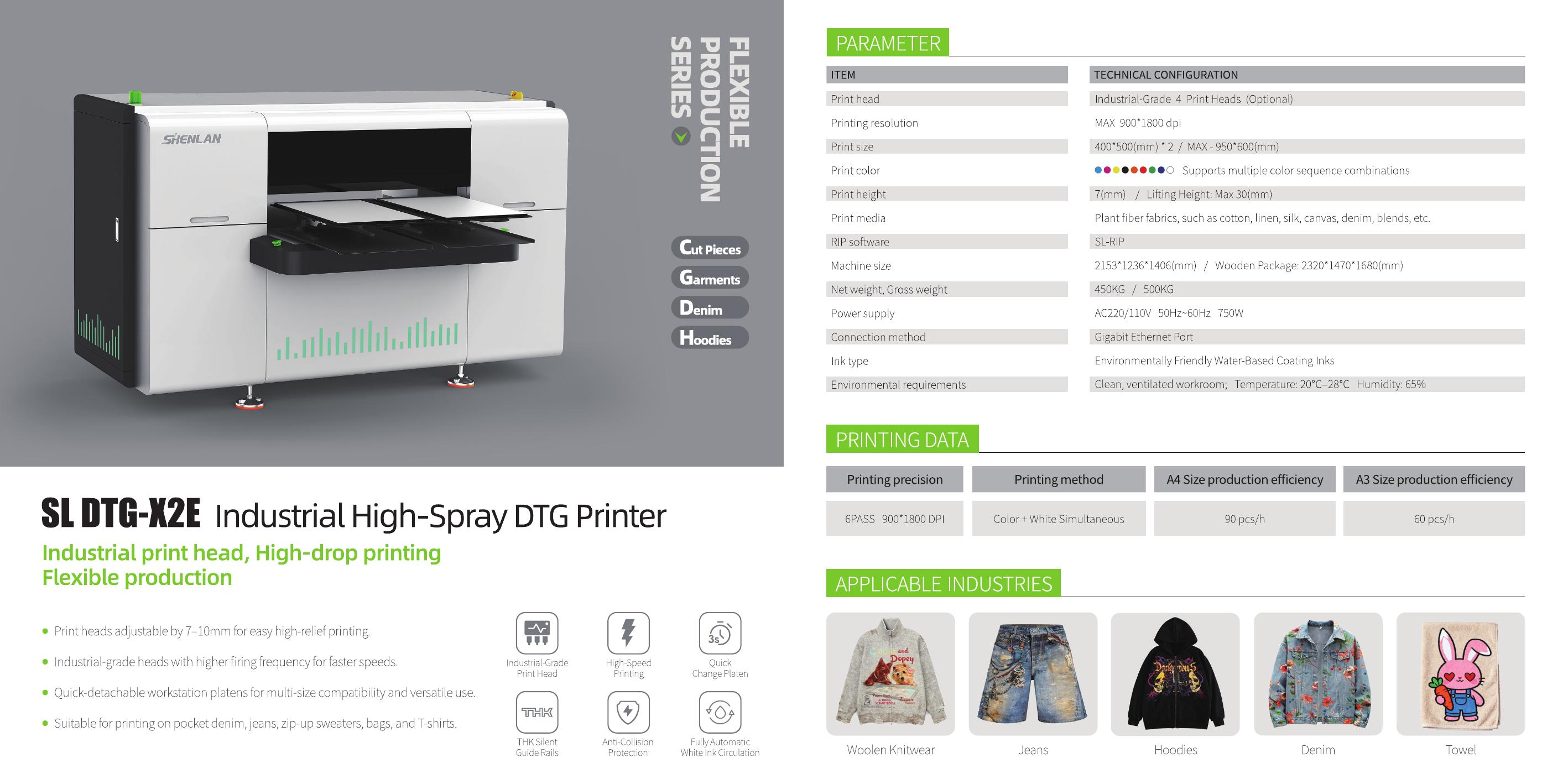
For reference, SHENLAN presents the SL DTG-X2S as an industrial DTG option with a maximum print area up to 600 × 450 mm and a two-industrial-print-head configuration. These are starting points for a discussion, not a substitute for testing a buyer's garments, artwork and workflow. Always request the current technical sheet before making a purchasing decision because specifications and configurations can change.
Ask for Evidence From Factory Testing and Shipment Inspection
B2B buyers should request evidence at two points: before order confirmation and before shipment.
Factory acceptance discussion
A useful factory test has an agreed checklist. It may include the target garment, selected artwork, placement, print mode, visual inspection criteria and photos or video of the finished result. Buyers should ask to see practical items such as nozzle checks, garment loading, the printed piece after curing, key controls and routine maintenance points. The purpose is not to create a theatrical demo; it is to align expectations before equipment is dispatched.
Pre-shipment inspection
Before packing, confirm machine identification, included accessories, visible condition, agreed configuration and export packaging. Ask how the equipment is secured for transport and what documentation is included for installation, operation and troubleshooting. Clear photos or a live video inspection can reduce uncertainty for international buyers, especially when the team cannot visit the factory in person.
Plan Installation Before the Shipment Leaves
Industrial equipment projects run more smoothly when installation preparation starts during production. Confirm floor loading, access route, doorway dimensions, power, ventilation, working clearance, curing equipment and operator training schedule. Allocate time to calibration, trial runs and producing approved samples after installation; the first week should not be treated as a fully optimised production week.
For cross-border projects, clarify the division of responsibility for freight, customs documents, local electrical work, installation guidance and spare-parts planning. A lower equipment quotation can become expensive if these responsibilities are unclear.
Compare Suppliers, Not Only Machines
An industrial DTG project is a long-term support relationship. Use a supplier comparison sheet that covers:
- production-fit recommendation and evidence behind it;
- clarity of technical specification and inclusions;
- response to fabric, white-ink and maintenance questions;
- factory-test process and shipment-inspection support;
- installation preparation materials;
- training format and post-installation support path;
- availability and identification of consumable and spare parts;
- realistic delivery and export documentation plan.
Be cautious with claims that are not connected to a test condition. “High speed,” “maintenance free” and “works on all fabrics” are not decision-ready statements. Ask what job was run, which materials were used, who performed the work and how the result was inspected.
FAQ
What is the difference between a commercial and industrial DTG printer?
The distinction is practical rather than purely marketing language. Industrial systems are selected for repeated production, workflow integration, operator access, service planning and more demanding garment volumes. The right category depends on the buyer's actual jobs, shift pattern and support requirements.
How should I compare DTG print speeds?
Compare timed jobs with the same garment colour, artwork coverage, print mode and white-ink requirement. Include loading and unloading where possible. A supplier should explain the conditions behind any output estimate.
Can an industrial DTG printer print on dark garments?
Industrial DTG workflows commonly support dark-garment printing using white ink and an appropriate pretreatment process. Results depend on the garment, artwork, pretreatment, printer settings and curing. Test the intended product before placing an order.
What should be included in a factory test?
At minimum: the buyer's representative artwork, target garment or equivalent fabric, defined placement, agreed print mode, visual inspection after curing and a record of the test. Add wash testing if it is part of the buyer's quality standard.
What information should I send when requesting a quote?
Share garments, fabrics, design dimensions, expected order type and volume, country, available installation space and target timing. These details produce a more useful recommendation than asking only for price.
Conclusion
The right industrial DTG printer is the one that makes your specific garment workflow more repeatable. Start with the jobs, then verify the print area, white-ink process, curing plan, installation conditions and support path. Use factory testing and shipment inspection to turn assumptions into documented checkpoints.